
Biphasic vs Monophasic Dermal Fillers: Full Comparison & Best Usage Guide
Compare granular biphasic HA filler and smooth monophasic gel filler. Check texture, advantages, suitable treatments for wrinkle removal & facial sculpting for aesthetic clinics.
Hyaluronic acid (HA) dermal fillers are the most mainstream minimally invasive cosmetic injectables worldwide. Based on manufacturing cross-linking technology and gel physical texture, HA fillers are divided into two core categories: biphasic granular HA filler and monophasic homogeneous gel HA filler.
Many aesthetic practitioners, salon owners and beauty enthusiasts struggle to distinguish their texture, advantages, and suitable injection areas. This detailed comparison guide breaks down all core differences to help you select the ideal filler for different facial treatment demands. It is also a professional reference for aesthetic clinics to optimize personalized injection plans for clients.
1. Core Specifications & Texture Difference
Biphasic Dermal Filler (Granular HA)
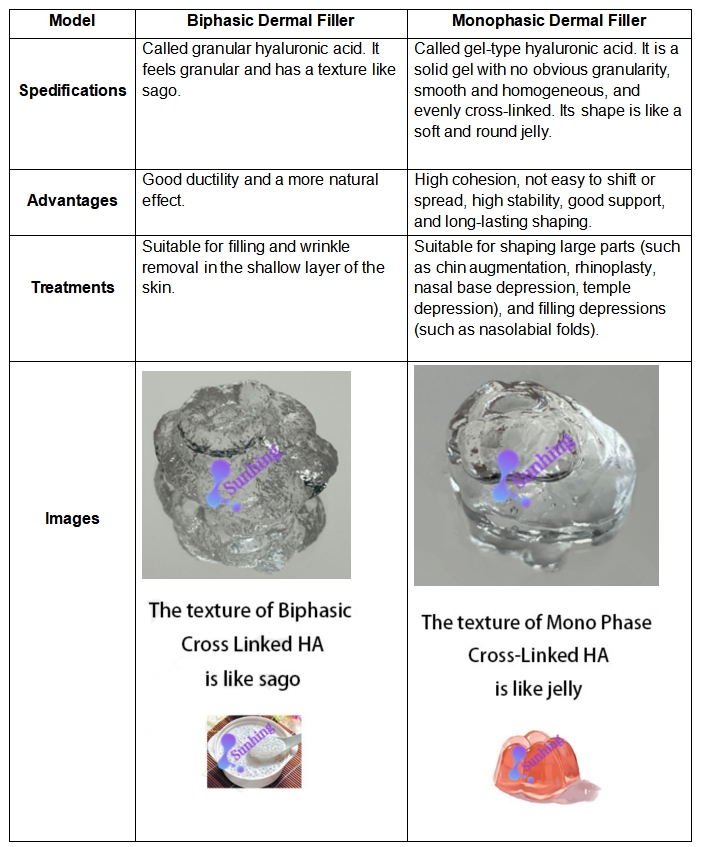
Biphasic filler is also named granular hyaluronic acid. Its internal structure contains separated HA gel micro-particles, creating an obvious grainy tactile texture highly similar to sago pearls.
The production process mixes solid cross-linked HA micro-granules with liquid uncross-linked HA carrier gel, forming a two-phase composite system with visible particulate feel when squeezed or touched.
Monophasic Dermal Filler (Solid Gel HA)
Monophasic filler refers to uniform gel-type hyaluronic acid. It is a fully integrated solid gel without separated granules. The HA molecules are evenly cross-linked throughout the whole product, delivering ultra-smooth, homogeneous consistency. Visually and tactilely, it resembles soft, bouncy jelly with zero grainy sensation.
2. Unique Advantages of Each Filler Type
Benefits of Biphasic Dermal Fillers
- Outstanding ductility & soft tissue integration
The granular structure can perfectly blend with shallow skin tissue after injection. It flows naturally under facial muscle movement without rigid unnatural lumps.
- Ultra-natural soft aesthetic effect
Ideal for subtle, soft-looking rejuvenation, matching the delicate texture of superficial facial skin layers.
Benefits of Monophasic Dermal Fillers
- Powerful cohesion & anti-displacement property
Integrated gel structure holds shape firmly; it will not shift, spread or deform under facial tissue pressure or muscle movement.
- Strong structural support & long-lasting shaping effect
Even cross-linking delivers stable three-dimensional lifting force. The sculpting result maintains longer with minimal early volume loss after injection.
3. Recommended Treatment Areas & Clinical Applications
Biphasic Fillers: Shallow Layer Wrinkle & Fine Line Correction
- Fine wrinkle filling (crow’s feet, perioral fine lines, forehead tiny lines)
- Shallow depressions, subtle skin unevenness
- Superficial hydration & delicate soft volume enhancement
Monophasic Fillers: Facial Sculpting & Deep Depression Correction
- Major facial contour augmentation
Chin enhancement, rhinoplasty (nasal bridge & tip shaping), temple volume restoration
- Deep fold & depression filling
Nasolabial folds, nasal base sagging depression, cheek volume loss
- 3D facial lifting & contour definition
4. How to Choose Between Biphasic and Monophasic Fillers?
Choose Biphasic Filler If You Need:
- Soft, invisible correction of shallow fine lines
- Natural light volume boost without stiff sculpting
- Superficial skin rejuvenation around delicate eye/mouth areas
Choose Monophasic Filler If You Need:
- Clear facial contour remodeling (nose, chin, temples)
- Repair of deep sagging folds and large volume loss areas
- Long-lasting, stable lifting shaping that resists shifting
Biphasic and monophasic hyaluronic acid dermal fillers are not superior to one another—they serve entirely different clinical purposes.
Professional injectors will match the filler type according to clients’ treatment goals, injection depth and target areas to achieve safe, satisfying aesthetic outcomes.
For aesthetic clinic operators and beauty content readers, mastering the difference between biphasic and monophasic fillers helps standardize injection protocols, answer client consultation questions professionally, and deliver targeted filler solutions for every facial rejuvenation demand.
For bulk wholesale of premium cross-linked HA dermal fillers, contact Sunhingmed to get free product samples and full technical parameters. You can also browse our full series of injectable fillers for clinic use on our product page.